Pixels, Lighting, and Craft: What Actually Separates Pro Spanking Content from the Rest
Anyone who's spent more than a few minutes browsing adult content online has had that moment — you click on something, and within seconds you're squinting at a grainy, badly lit clip that looks like it was filmed inside a sock drawer. Then you click on something else and it's immediately, obviously different. Crisper. More composed. You don't even know exactly why it feels better, but it does.
That gap isn't accidental. It's the product of deliberate craft — technical knowledge, artistic instinct, and a genuine investment in the viewer's experience. In the spanking content space specifically, that gap tends to be especially pronounced. Here's why.
Lighting Is Everything (And Most People Get It Wrong)
Ask any professional photographer what separates good images from forgettable ones, and the answer almost always starts with light. In spanking content, this becomes even more critical because so much of the visual storytelling happens on the skin itself — the flush of impact, the subtle color change across a curve, the contrast between shadow and highlight that communicates texture and sensation.
Amateur setups typically rely on whatever ambient light is available: overhead room lighting that casts harsh, unflattering shadows, or natural window light that shifts throughout a shoot and creates inconsistency from frame to frame. The result is content where the key visual element — the subject's body — ends up looking flat, washed out, or weirdly greenish from a fluorescent bulb nobody thought to swap out.
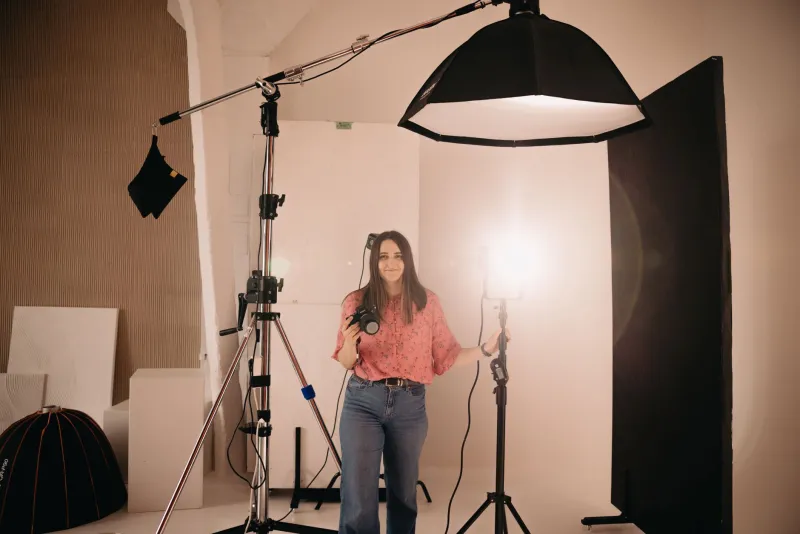
Professional creators approach lighting as a deliberate compositional choice. Softboxes and diffused light sources eliminate harsh shadows while still maintaining enough contrast to show definition. Rim lighting — a subtle backlight placed behind the subject — creates separation from the background and gives the image a sense of depth that flat, single-source setups simply can't achieve. Some producers even use color-temperature adjustments to bring warmth to skin tones, which makes a significant difference in how the final image reads emotionally.
Camera Angles Aren't Just About What You See — They're About What You Feel
Angle selection in spanking photography is where a lot of amateur content really starts to fall apart. The instinct for inexperienced shooters is to position the camera at whatever height is easiest — usually eye level — and leave it there. The problem is that eye level is almost never the most interesting or evocative perspective for this kind of content.
Professional creators think about angles the way filmmakers do: every degree of rotation, every shift in height changes the emotional register of the image. A low angle can create a sense of scale and drama. A tighter crop from slightly above emphasizes vulnerability. A wide establishing shot communicates context — the setting, the dynamic, the relationship between the people in frame.
In still photography, composition choices are permanent — you can't reframe in post. That means pro photographers are constantly adjusting during the shoot itself, moving around their subjects, trying multiple angles, and thinking about how each frame will read to someone viewing it cold with no context.
The Gear Gap Is Real, But It's Not the Whole Story
It's tempting to think that professional-looking content just requires expensive equipment, and while gear does matter, it's not the primary differentiator. A skilled photographer with a mid-range mirrorless camera and a couple of good lenses will consistently outperform an unskilled shooter with a top-of-the-line setup.
That said, certain technical capabilities do make a meaningful difference in the spanking content space. Higher-resolution sensors capture skin texture in ways that cheaper cameras simply can't resolve. Fast lenses — those with wider apertures — allow for the kind of shallow depth of field that separates a subject from the background and creates that polished, intentional look that viewers associate with premium content. And quality audio equipment, for video content, transforms the experience in ways that are almost subconscious — the sound of impact, the ambient atmosphere of the space, the quality of spoken exchanges.
Post-Production: Where Good Becomes Great
Here's something that casual viewers often don't realize: a huge portion of what makes professional content look the way it does happens after the shoot is over. Post-production editing — color grading, retouching, exposure adjustment, cropping — can dramatically elevate raw footage or images that look decent into something that feels genuinely polished.
Color grading, in particular, is an art form unto itself. The right grade can give content a specific mood or aesthetic — warmer tones feel more intimate, cooler tones create a different kind of tension. Consistent grading across a series of images or a video creates a cohesive visual identity that viewers start to associate with a creator's work.
Amateur content rarely goes through this process, or goes through it minimally. The result is content that looks like exactly what it is: unprocessed, unintentional, and a little rough around the edges.
Why Viewers Are Noticing More Than They Think
Here's the thing about quality: you don't have to be able to articulate why something looks good to respond to it. Viewers who've spent time with premium spanking content develop an intuitive sense for production value, even if they couldn't explain the difference between a softbox and a ring light.
This is why the market for professionally produced content has remained strong even as the internet has been flooded with amateur material. There's genuinely a consumer preference for content that feels considered — where someone clearly thought about what the viewer would experience and made deliberate choices to enhance that experience.
For content creators working in this space, that's both a challenge and an opportunity. The bar for what qualifies as "good enough" has risen significantly as audiences have become more visually sophisticated. But creators who invest in developing real technical and artistic skills — who treat spanking content as a craft rather than just a product — consistently build more loyal audiences and command more sustainable careers.
The Craft Argument
There's a version of this conversation that gets a little pretentious — people talking about adult content creation like it's fine art photography, complete with references to lighting theory and compositional philosophy. But underneath the potential for eye-rolling, the core point is valid: quality is intentional, and intention shows.
The best spanking content out there — the stuff that actually stays with you, that you come back to — was made by people who cared about more than just capturing an act on camera. They cared about how it looked, how it felt to watch, what mood it created. That level of investment is visible in every frame.
And for viewers who've been around long enough to know the difference, that's exactly what they're paying for.